






Railway Chai Wala

 Loading...







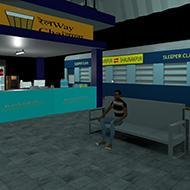
You slide a glass of chai across the counter, and the passenger doesn’t say thank you. He just stares at the tracks, then at you, then at the tracks again. The kettle is still hissing behind you, samosas are frying too long, and somewhere down the platform a train horn cuts through the noise. This is a normal shift at Fakripur station in Railway Chai Wala, and it is also the moment the game stops being a simple cooking sim and starts being something else entirely.
| Genre | Simulation, Cooking, Psychological Horror, Mystery |
| Perspective | First-person |
| Setting | Fakripur railway station |
| Playable Character | Ramu, the station chaiwala |
| Release | March 7, 2025 |
| Player Count | Singleplayer |
Ramu’s Daily Grind at Fakripur Station
Ramu is not a hero in the traditional sense. He is a chaiwala running a small stall on a busy platform, and for the first stretch of the game his problems are practical ones: keep the chai brewing, don’t let the coffee go cold, and get samosas out before the next train pulls in. The core mechanic of the game is built around this rhythm, and it works because the tasks feel physical rather than abstract. You measure, you pour, you plate, and you hand things over the counter to whoever is standing there.
Cooking-sim regulars will recognize the loop instantly, but Fakripur adds pressure that most kitchen games don’t bother with. Passengers don’t wait patiently. Trains arrive on a schedule that doesn’t care whether your kettle is ready, and a missed order isn’t just a lost sale, it’s a small crack in the illusion that everything at the station is normal.
Early in the game, the tasks are almost meditative. Brew, serve, repeat. That changes once players start noticing details that don’t add up, and this is where the game quietly shifts genres without ever announcing it.
Brewing, Serving, and the Kokila Kola Problem
The menu at Ramu’s stall is small but specific. Chai and coffee are brewed to order, samosas are fried in batches, vada pav gets assembled on the spot, and Kokila Kola is poured cold for anyone who wants something other than tea. None of these items are generic placeholders, and the game leans on that specificity to make the stall feel like a real business rather than a UI wrapped around a timer.
Getting an order wrong matters more than it first appears. Serve cold chai or hand over a soggy samosa and some passengers just grumble, but others react in ways that feel disproportionate to a bad snack, which is one of the first hints that Fakripur isn’t a normal station.
- Chai and coffee brewing, timed against the next train’s arrival
- Samosas and vada pav, prepared in short cooking windows
- Kokila Kola, served cold and often requested by the same recurring faces
Passengers and the Cast of Railway Chai Wala
The station is populated by a rotating cast of travelers, and a handful of them reappear often enough that players start tracking their behavior. Horror-focused players tend to fixate on these repeat visitors first, since their dialogue shifts slightly each time they return, while players coming from a story-rich background pay closer attention to what they say than to what they order.
By the time you reach the later shifts at the stall, several of these regulars stop behaving like background characters entirely. Their timing lines up with strange occurrences elsewhere on the platform, and the game never explains this outright. It expects you to notice.
What Railway Chai Wala Doesn’t Tell You Upfront
The store page frames this as a psychological thriller with an Indian setting, but the actual pacing takes its time getting there. The first sessions are almost entirely about the stall, and players expecting immediate scares sometimes bounce off the slow build. This is one of the more debated aspects among people discussing the game, since the horror is more atmospheric dread than jump-scare heavy, and reviewers have openly split over whether that restraint works in the game’s favor or makes the mystery feel undercooked.
Once the station’s stranger elements start surfacing, the earlier cooking loop takes on a different weight. A late train, an unusually quiet platform, or a passenger who orders the same thing every single time stops feeling like flavor text and starts feeling like a clue.
Frequently Asked Questions
How do you unlock the mystery ending in Railway Chai Wala?
Progress comes from continuing to run the stall and paying attention to dialogue from Ramu’s recurring customers rather than from a hidden menu option. The story unfolds as later shifts at Fakripur station introduce new conversations tied to the station’s secrets, and skipping through dialogue quickly is the most common reason players miss context needed for the ending to make sense.
What happens if you serve the wrong order to a passenger?
Most passengers simply react with mild annoyance, but a few of the recurring characters respond in ways that hint at something off about them, which several players treat as an early signal of the game’s horror layer rather than just a scoring penalty tied to chai or samosa quality.
Is Railway Chai Wala actually scary or just a cooking sim?
It runs mostly as a cooking sim with slow-burn horror layered underneath rather than constant scares, and whether that balance lands depends on what a given player wants from it. People expecting a straightforward jump-scare horror game tend to find the tension too gentle, while those drawn in by the mystery tag generally rate the atmosphere as the strongest part of the experience.
What stays with most players after finishing Railway Chai Wala isn’t a single scare but the accumulated weight of small details at Fakripur station: Ramu’s kettle still hissing, the same face ordering Kokila Kola for the third time, a train that arrives a little too late. It’s a modest cooking sim on the surface, and that surface is exactly what makes the station’s quieter secrets land as hard as they do.
Comments
There are no reviews yet. Be the first one to write one.