







Little Horrors: The Mortuary


 Loading...








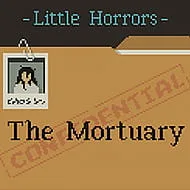
You’re asleep when the phone rings, and it rings the kind of way that means something is wrong. Your coworker is working the night shift at the mortuary and now he’s not answering, trapped somewhere near the storeroom, and the only thing to do is get dressed and go find him. That midnight call is the entire premise of Little Horrors: The Mortuary, and the game spends every one of its few minutes making that walk feel heavier than it should.
| Genre | Point-and-click horror adventure |
| Perspective | 2D, fixed-screen pixel art |
| Average session | A few minutes |
| Core mechanic | Interact and examine using two mouse buttons |
Walking Into Little Horrors: The Mortuary
The setup doesn’t waste time explaining itself. You’re woken up, told your coworker is stuck, and sent toward the building without much else to go on. That restraint is deliberate — the game leans on silence and implication rather than exposition dumps, and the first few screens exist mainly to establish that something in the storeroom isn’t behaving the way a storeroom should.
Movement and investigation both run through the same input: the primary mouse button moves your character or interacts with whatever you’ve clicked, while the secondary button examines objects or pushes dialogue forward. It’s a minimal control scheme, but it fits a game this short, and it means nothing gets in the way of just looking at the room.
Early on, the pacing is patient almost to a fault. You’ll cross the same hallway more than once, checking doors and drawers, before the storeroom itself becomes reachable. Players who go in expecting jump scares from minute one tend to be surprised by how much of the opening is just quiet observation.
Interact and Examine: The Two Verbs That Run the Game
Everything you do in the mortuary funnels through interact and examine, and the game expects you to lean on examine constantly. Objects that look like set dressing often aren’t — a detail on a shelf or a mark on a door can matter later, and because there’s no hint system, missing an examine prompt is the most common way players get stuck.
The pixel art itself is chunky and low-resolution by design, and that choice does a surprising amount of work. Large, simplified pixels mean the game can’t rely on fine detail to sell horror, so it leans on silhouette, sound, and negative space instead — a shape half-visible at the edge of a dark room reads as threatening precisely because you can’t confirm what it is.
Lighting sits at the center of that effect. Rooms shift between lit and unlit states as you move through the mortuary, and several of the game’s tensest moments happen simply because a light source goes out and you have to keep going anyway.
- Primary click to move your character or interact with objects
- Secondary click to examine items or advance dialogue
- Escape opens the pause menu at any point
The Storeroom and What’s Actually Wrong There
The storeroom is where the game’s premise finally pays off, and without spoiling the specifics, it’s built around a slow reveal rather than a single scare. Community discussion around Little Horrors: The Mortuary tends to focus on this stretch specifically, since it’s where the pixel-art restraint and the sound design work together most effectively.
Once you’re inside, the storeroom rearranges what you thought the earlier hallways were telling you. Backtracking players — the ones who like to recheck every prior room after a story beat lands — will notice small environmental changes that reframe what they walked past earlier without realizing it.
First-time players and completionist players tend to split here: one group pushes straight through to the ending, while the other doubles back through every examinable object once the storeroom reveal changes the context of the mortuary.
What Little Horrors: The Mortuary Leaves Unresolved
The most honest criticism the game draws, even from people who rate it highly, is length. It’s short by design — a few minutes, not an evening — and the ending arrives with clear intent to continue the story in a later entry rather than closing every loop. Some players find that satisfying as a taste of a longer series; others find it abrupt.
That divisiveness doesn’t undercut what’s here. The atmosphere, particularly the lighting and the sound design layered under the pixel art, holds up on repeat viewings even once the surprise is gone.
How long does Little Horrors: The Mortuary take to finish?
A single playthrough runs a few minutes, closer to a short story than a full adventure game, with most of that time spent examining the mortuary’s rooms before reaching the storeroom.
Do you need to solve puzzles to reach your coworker?
Progress depends on examining objects rather than solving traditional item-combination puzzles — missing an examine prompt on a door or shelf is what typically stalls players before the storeroom.
Is Little Horrors: The Mortuary more jump scares or atmosphere?
It leans almost entirely on atmosphere, using lighting changes and quiet pacing rather than repeated jump scares, which is part of why it holds a 4.8-star average across its ratings.
Little Horrors: The Mortuary earns its short runtime by trusting silence over spectacle, and the storeroom sequence is the clearest proof that a game doesn’t need length to leave an impression. Whether you finish it in one sitting or go back through the mortuary’s hallways to catch what you missed, it’s a tight, deliberate piece of pixel-art horror that ends exactly where it means to.
Comments
There are no reviews yet. Be the first one to write one.