








Dirt Clicker


 Loading...








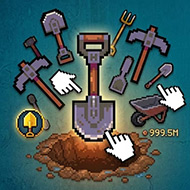
What actually happens once your workers outpace your own clicking? That’s the question Dirt Clicker quietly puts in front of every player who sticks around past the first layer, and the answer shapes most of the decisions that follow.
At the outset, Dirt Clicker gives you almost nothing: a spoon, a patch of dirt, and a single button to press. The game is upfront about this — it’s part of the pitch — and the early minutes are meant to feel a little absurd, digging with cutlery while the promise of tools and helpers sits just out of reach.
From Manual Clicks to Automated Digging
The transition away from pure clicking is gradual rather than sudden. Mushroom Buddies show up on the hire list before most players have saved enough currency for anything flashier, and their low cost makes them an easy impulse buy the moment they unlock. Their output is modest on its own, but stacking two or three of them side by side closes the gap with manual clicking faster than it looks like it should.
That balance shifts once Dirt Golems enter the picture. They’re built for output rather than nuance, and a player who leans on them heavily can watch their digging rate climb sharply within a short stretch of play. Druids sit outside that scaling curve entirely. They contribute nothing to the dig count on their own, only amplifying whatever is standing near them, so a run that hires a Druid before anything else worth boosting is effectively wasting a hire slot.
Getting this balance wrong is one of the more common stumbling points. Overinvesting in one helper type early tends to plateau, while a mixed team — even a small one — keeps momentum longer.
What the Skill Tree in Dirt Clicker Rewards
The skill tree is where most of the long-term strategy lives. It touches digging power, worker output, and loot odds, and it’s broad enough that a player can specialize toward speed, toward automation, or toward loot quality without any one path feeling mandatory.
Some of the higher-tier nodes unlock spells, and a handful sit noticeably above the rest in what they let you get away with — skipping cooldowns, stacking effects that normally cancel out, that kind of thing. Getting there takes real commitment to the tree first, so most players don’t see these until well past their first few layers.
Layers, Relics, and the Cost of Moving Too Fast
Each layer in Dirt Clicker holds its own loot, its own relics, and scattered puzzle pieces that aren’t always necessary to progress but often make the next stretch easier. A player racing toward depth can clear a layer quickly and still come out behind someone who took the time to dig it out fully.
This creates a genuine trade-off rather than an obvious right answer. Rushing keeps the pace exciting and gets you to new content sooner. Exploring fully means slower short-term progress but a stronger foundation once you hit the layers where difficulty picks up.
Either approach is valid, and that’s part of what gives the game replay value beyond a single straightforward run.
Keeping an Idle Setup Honest
Dirt Clicker tracks stats on each worker, which becomes genuinely useful once you’re running more than one or two helpers at a time. It’s easy to assume a setup is running efficiently when really one Dirt Golem is doing most of the work while a Druid sits with nothing left to boost.
Over 40 items exist to be dug up across the game, ranging from ordinary loot to the rarer treasures tied to badges and milestones. Chasing all of them is a different kind of goal than simply pushing deeper, and it tends to appeal to a different type of player.
How many workers can you unlock in Dirt Clicker?
There are more than five distinct helper types to unlock, including Mushroom Buddies, Dirt Golems, and Druids, each contributing to the dig in a different way rather than simply adding more raw output.
Why does my digging rate suddenly slow down after the first layer?
This usually means the skill tree and worker setup haven’t kept pace with the new layer’s demands — sticking with early tools or an unbalanced team is the most common cause.
Are the spells in Dirt Clicker worth pursuing early?
Some spells are powerful enough to meaningfully accelerate progress, but they sit deeper in the skill tree, so reaching them usually requires a foundation of digging power and worker automation first.
Dirt Clicker rewards patience more than it first appears to. The players who slow down long enough to check their worker stats, dig out a layer instead of rushing past it, and hold off on hiring a Druid until there’s something worth boosting tend to end up further ahead than the ones chasing depth alone.
Comments
There are no reviews yet. Be the first one to write one.