


Rhythm Heaven Megamix


 Loading...





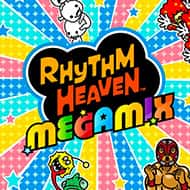
What happens when the beat drops out and you’re still expected to know exactly where the next cue lands? That’s the question every new player runs into within the first hour of Rhythm Heaven Megamix, a game built on the idea that rhythm alone — not visible prompts — should carry you through each minigame.
| Genre | Rhythm Game |
| Platform | Handheld |
| Minigame Count | Over 100, spanning the series |
| Structure | Story mode plus Endless Games and Rhythm Toys |
Tibby, Heaven World, and the Framing Story
Unlike most entries in the series, Rhythm Heaven Megamix wraps its minigames in an actual narrative thread. Tibby falls out of Heaven World and lands in Earth World, and the player spends the game helping him find his way back home, climbing through towers of minigames along the way. It’s a light framing device, but it gives the game a sense of forward motion that earlier entries didn’t bother with.
Tibby also becomes something of a divisive figure among longtime fans. Some find him a charming mascot; others consider him the most grating part of the whole game. Either way, he’s impossible to avoid, since he narrates transitions between towers and shows up constantly in the café hub.
Stage Towers and the Land System
Minigames are grouped into towers of four, pulling one game each from the earlier Rhythm Tengoku, Rhythm Heaven, and Rhythm Heaven Fever titles alongside one new entry, capped off with a Remix that stitches the set together into a single continuous track. Honeybee Land, Machine Land, Citrus Land, and Barbershop Land each repackage familiar minigames with new visuals and music, while the Lush Tower marks the point where Remix stages start layering multiple games into one performance.
This structure means beginners rarely face an unfamiliar minigame in isolation. Difficulty ramps gradually tower by tower rather than spiking randomly, though certain individual games — Ninja Bodyguard and Lockstep come up constantly in community discussion as outliers that punish players who haven’t internalized the timing yet.
What Beginners Get Wrong About Timing
New players consistently try to react to visual cues the instant they appear on screen. Rhythm Heaven Megamix punishes that instinct almost immediately, because the visual cue and the correct input beat are rarely the same moment. The game wants you to internalize the music itself, not the animation layered on top of it.
- Play a failed minigame’s practice mode before retrying the real thing
- Listen for the backing track’s pulse rather than watching character animations
- Treat Superb ratings as a long-term goal, not a first-attempt expectation
Once that shift happens, minigames that felt impossible on a first attempt often click within two or three replays.
Endless Games, Rhythm Toys, and the Café
Outside the main story, Rhythm Heaven Megamix keeps a handful of Endless Games running — one carried over from each prior installment plus a new addition — which strip away scoring pressure in favor of pure repetition and rhythm practice. The café hub adds smaller distractions: a dog barista to chat with, a StreetPass-based Figure Fighter Duel challenge, and a pachinko-style minigame where turnips get fed to a goat for no reason beyond charm.
The Stable minigame lets players earn collectible Mascots, which can replace Tibby as the game’s loading icon once unlocked — a small reward system that gives completionists something to chase well after the story ends.
Chasing Perfects Through the Rainbow Towers
Clearing every minigame with a passing grade is one thing; earning Superb ratings across the Rainbow Towers is another challenge entirely, and it’s where the game’s difficulty curve really shows its teeth. Precision-focused players tend to gravitate toward this endgame loop, replaying individual minigames dozens of times to shave input errors down to zero, while more casual players are often content clearing the story once and dipping into Endless Games afterward.
Rhythm Heaven Megamix FAQ
- Why do I keep failing minigames even when I think my timing is right? Most missed inputs come from reacting to the visual animation instead of the underlying beat. Games like Karate Man and Spaceball are built around musical timing first, with animation as a secondary layer, so leaning on sound over sight usually fixes the issue.
- What’s the difference between the short and long versions of returning minigames? Games appearing in Honeybee Land, Machine Land, Citrus Land, and Barbershop Land are shortened arrangements with new music, while their full-length originals appear elsewhere in the story under different names, carried over from earlier entries in the series.
- Is there content after finishing the main story? Yes — Endless Games, Rhythm Toys, the Stable’s Mascot collection, and pushing every minigame toward a Superb rating in the Rainbow Towers all extend play well past the credits.
Rhythm Heaven Megamix asks for more patience than its cheerful presentation suggests, and the gap between a first clumsy attempt at Ninja Bodyguard and the moment its rhythm finally clicks is exactly the kind of payoff that keeps players returning to Tibby’s towers long after the main story wraps up.
Comments
There are no reviews yet. Be the first one to write one.