







Particle Life

 Loading...








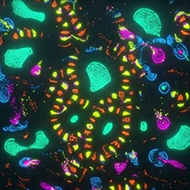
Life, in Particle Life, doesn’t come from intelligence or intention — it comes from one deceptively simple asymmetry: red particles can be attracted to green while green particles are repelled by red, and that single mismatched rule is enough to make red visibly “chase” green across the screen without anyone scripting a chase behavior at all.
Attraction and Repulsion as the Only Real Rules
Each particle species carries its own relationship to every other species, and those relationships don’t have to run in both directions. A handful of colors, each governed by asymmetric attraction and repulsion values, is enough to produce swirling clusters, orbiting formations, and pursuit behavior that nobody directly designed.
Friction and the Repulsion Floor
A global friction setting keeps particles from accelerating endlessly, while a short-range repulsion prevents them from collapsing into a single point — functioning almost like a degeneracy pressure that keeps matter from imploding under its own pull in real physics.
Chasing a Definition of “Life-Like”
Most versions ship with presets tuned toward specific emergent behaviors, but the real draw for most players is adjusting the underlying force matrix directly. The community keeps circling the same unresolved question — what actually counts as “life-like” behavior — since the term resists a clean definition even among people who’ve spent hundreds of hours tuning the rules themselves.
The Hand of God Feature
Some builds include an interactive tool that lets players herd particles by swiping or beckon them by pressing, turning passive observation into something closer to guided experimentation with a system that otherwise runs entirely on its own logic.
Solving the Performance Problem With Space Partitioning
Because every particle theoretically interacts with every other particle, naive implementations scale terribly as counts climb. Space partitioning divides the simulation into regions so particles only calculate forces against nearby neighbors, letting browser-based versions handle far larger populations without collapsing under their own math.
3D Extensions and Deeper Particle Properties
Some Particle Life projects extend the core rules into three dimensions, adding mass, energy, and an energy transfer threshold that determines when momentum passes between particles — a level of complexity that goes well beyond the original two-rule concept.
What actually makes Particle Life different from standard physics simulations?
Standard simulations apply uniform, symmetric rules to every object, while Particle Life deliberately allows asymmetric, per-species relationships, and that asymmetry is exactly what produces its unpredictable, organism-like motion.
Why do some configurations just scatter instead of forming clusters?
Poorly balanced attraction and repulsion values tend to produce chaotic scattering rather than structure, which is why carefully tuning the force matrix is the actual skill behind coaxing compelling emergent behavior out of the system.
Particle Life makes a genuinely strange point about complexity: you don’t need goals or intelligence to get behavior that reads as alive, just a handful of mismatched attraction and repulsion values — and watching a cluster form, chase, and split apart on screen is enough to make that point land.
Comments
There are no reviews yet. Be the first one to write one.