




Demon Bluff


 Loading...






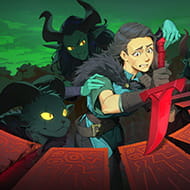
In Demon Bluff you start each round with a row of facedown cards and ten health, and that number matters the moment your first wrong execution takes a chunk out of it. Everything else in the game builds outward from that single tension: flip cards, weigh what they claim to know, and decide who dies before your health runs out.
| Genre | Single-player social deduction roguelike |
| Core Mechanic | Reading character claims to identify and execute Evil roles |
| Starting Health | 10, with a 5-point penalty per wrong execution |
| Role Count | Over 20 unique characters across four types |
| Progression Goal | Ascension levels, capped by reaching Village 12 |
Flipping Cards and Reading Claims in Demon Bluff
The core loop is deceptively simple to describe: reveal a character card, read what it claims about the village, and cross-check that claim against everything else you’ve learned so far. Good roles want to help you, but that doesn’t mean their information is always easy to interpret correctly.
The Lover, for instance, tells you how many Evil characters sit beside it in the circle, while the Enlightened points toward the nearest Evil in a given direction. Individually these clues feel manageable, but Demon Bluff is built around forcing you to hold several of them in your head at once and notice where they contradict each other.
New players consistently make the mistake of trusting the first confident-sounding claim instead of waiting to cross-reference it. That habit works fine on early villages and falls apart almost immediately once contradictory information starts appearing.
Villagers, Demons, Minions, and Outcasts
Every card in the game falls into one of four categories, and understanding the difference is the first real skill the game asks you to build.
- Villagers are generally trustworthy and provide information or protective effects when read correctly
- Demons actively lie and represent the core threat you’re trying to identify each round
- Minions support the Demons by lying convincingly while appearing to be ordinary Villagers
- Outcasts are good characters with a harmful twist, complicating what “safe” actually means
The Wretch is a good example of that last category, since it appears Evil to other roles’ abilities despite technically being on your side, which means trusting an ability’s readout at face value can quietly sabotage your own run.
The Judge, the Wretch, and Other Divisive Roles
The Judge lets you check a single other character to see whether they’re lying, which sounds powerful until you realize you only get to use it once and have to decide exactly when it’s worth spending. Players frequently debate whether to burn the Judge’s ability early for safety or hold it until the village narrows down to genuinely ambiguous suspects.
Not every role lands equally well with the community, and it’s worth being upfront about that. The Druid, whose ability is meant to flag disguised Outcasts, gets brought up regularly in player discussions as feeling unreliable, with some describing readouts that don’t match what they expect from the role’s stated ability.
That kind of inconsistency is exactly the sort of thing casual players shrug off during a single run but that dedicated deduction players treat as worth documenting and discussing in detail.
Health, Executions, and the Cost of Being Wrong
With ten total health and a five-point penalty for each wrong execution, Demon Bluff gives you very little room for error. Two bad guesses in a single village is usually enough to end your run outright, which keeps the pressure on even after you’ve built a reasonably confident read.
This scoring system is also why the community treats reckless flipping as a beginner tell. Executing based on a hunch instead of cross-checked evidence might work early on, but it becomes an unaffordable habit once ascension levels start introducing harder role combinations.
Advanced players tend to slow down deliberately in the middle of a village, resisting the urge to execute the moment a suspect emerges, and instead waiting for a second piece of contradicting information before committing.
Doppelgangers and Duplicate Roles in Demon Bluff
One of the more important rules to internalize is that most roles only appear once per village. Seeing a duplicate is a major tell, usually pointing to a Doppelganger copying an existing role or an Evil character bluffing as something it isn’t.
Once you reach the point in the game where Doppelgangers start appearing regularly, the entire deduction process shifts. You’re no longer just evaluating whether a claim sounds consistent, you’re actively checking the roster for role collisions that shouldn’t exist.
This mechanic tends to be the moment players describe as when Demon Bluff “clicks,” since spotting a duplicate role for the first time reframes how you approach every claim afterward.
Ascension and the Push Toward Village 12
Village 12 currently functions as the finish line for a full run, and reaching it means surviving increasingly complex role combinations as ascension climbs. Each ascension level tends to introduce either new roles or nastier interactions between existing ones, rather than simply scaling numbers up.
The roguelike deckbuilding mode adds another layer on top of this, letting players choose which characters enter the pool for a given run rather than facing a fully randomized set every time.
Completionists chase every unlockable role and push ascension as far as it goes, while players who prefer a tighter puzzle often stick closer to the base village count, treating each session as a self-contained logic problem rather than a long-term climb.
How does the Doppelganger work in Demon Bluff?
The Doppelganger copies the role of an existing character in the village, which means spotting two characters claiming the same role is often the clearest signal you’ll get that something is wrong, since most roles are designed to appear only once.
What happens if you execute a good character by mistake?
A wrong execution costs five of your ten health, which is steep enough that two mistakes in the same village will typically end your run, making careful cross-referencing far more valuable than acting on a first impression.
Is Demon Bluff based on Blood on the Clocktower?
It draws clear inspiration from that tabletop format but reworks it into a single-player puzzle, replacing group discussion and live bluffing with a structured system of claims you piece together on your own.
Between the Judge’s single-use gamble, the quiet threat of a Wretch throwing off your reads, and the moment a duplicate role finally tips you off to a Doppelganger, Demon Bluff turns a genre usually built around groups of people into something that works surprisingly well alone. Village 12 waits at the end of it, but most players will tell you the real hook is that first village where the claims finally stop lining up cleanly.
Comments
There are no reviews yet. Be the first one to write one.