




La Madriguera

 Loading...




What actually happens the moment a dragged object stops behaving the way you expected? That question comes up constantly around La Madriguera, because the game’s entire structure depends on physics that stay consistent but rarely feel fully predictable on the first attempt. There’s no script guiding the cake toward the bear — only weight, contact, and whatever the player decides to move next.
A Den Full of Furniture That All Doubles as Tools
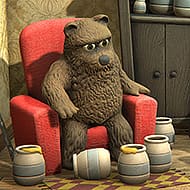
The setting is small on purpose. A bear sits in an armchair at the back of a cluttered den, and directly ahead of him sits a slice of chocolate cake he refuses to walk toward. Everything between the armchair and the cake — side tables, lamps, rugs, loose cushions — exists to be manipulated rather than admired. Nothing about the room is purely visual; if an object can be dragged, it’s probably part of at least one working solution.
This design choice is what separates La Madriguera from puzzle games that hand players a toolbox of abstract mechanics. There’s no special ability to unlock, no new tool introduced halfway through. The entire puzzle space is whatever’s already sitting in the room, which forces players to treat ordinary furniture as if it were a set of interlocking parts.
Some players find this restrictive. Others find it exactly the point — the challenge isn’t learning new systems, it’s noticing what the existing objects can actually do once gravity gets involved.
Why the Bear Never Leaves the Armchair in La Madriguera
The bear’s refusal to stand up isn’t just a joke layered on top of the puzzle — it’s the mechanical foundation the whole game rests on. Because the player can never move the bear directly, every solution has to be delivered to him rather than the other way around. That single restriction reshapes how each puzzle gets solved: instead of asking where to go, the player is constantly asking what needs to move for the cake to arrive on its own.
It’s a small inversion, but it changes the pacing considerably. Traditional puzzle-platformers reward exploration and movement. La Madriguera rewards patience and precise manipulation of a paw that only ever reaches as far as the nearest object.
Reading Weight and Balance Before Committing to a Drag
Real-time physics governs everything in the den, and understanding how objects respond to force is more valuable than memorizing any specific solution. Heavier furniture resists small nudges but carries momentum once it finally tips. Lighter objects react instantly but can overshoot a target just as easily as they hit it. Players who spend a few seconds studying an arrangement before dragging anything tend to waste far fewer attempts than players who react immediately.
- Identify which object is closest to affecting the cake directly
- Trace what happens to nearby items if that object falls or tips
- Adjust for weight — heavier pieces need a bigger push to start moving at all
- Watch for secondary collisions that can undo progress a moment later
Trial-and-error players tend to treat this stage as a series of small experiments, restarting quickly whenever something goes sideways. More cautious players prefer to plan the full sequence mentally before making a single move, accepting a slower pace in exchange for fewer wasted attempts.
The Restart Key and the Value of Cheap Failure
Pressing R resets the level instantly, and this single design decision does a lot of quiet work. Because failure costs nothing beyond a few seconds, players are encouraged to test risky ideas rather than protect a fragile setup that’s already halfway collapsed. This is part of what players mean when they describe La Madriguera as forgiving despite being fiddly — the frustration comes from imprecise physics, not from any punishing structure layered on top of it.
Some solutions even benefit from what the puzzle community calls cheesing — finding an unintended shortcut that technically satisfies the objective without following the logic the level seems to be teaching. It’s not against any rule, and plenty of players enjoy hunting for these shortcuts as much as the intended solution itself.
Where the Humor and the Puzzle Overlap
A lot of the game’s personality comes from watching careful plans fall apart in ways that are funny rather than frustrating. A lamp rolling off the edge of a table, a cushion catapulting a cushion instead of the cake, or a chair tipping in the exact wrong direction — these moments land as comedy precisely because the physics is taken seriously enough to produce genuinely unpredictable outcomes.
That unpredictability is also the game’s most debated quality. Some players love the loose, chaotic feel of watching objects interact in real time. Others find it occasionally unfair when a solution that should logically work fails due to a physics quirk rather than a flaw in the player’s reasoning. Both reactions are common, and both are reasonable given how much of the challenge depends on execution rather than pure logic.
- What happens if I move the wrong object first in La Madriguera? Nothing resets automatically — the arrangement stays as it is until you either recover the situation manually or press R to start the level over from its original layout.
- Does La Madriguera get harder as you go? Since the core experience centers on one dense puzzle rather than a long progression, difficulty comes from precision and observation rather than an increasing number of stages.
- Can you finish La Madriguera without understanding the physics? Rarely — most accidental successes still involve noticing how an object reacted to a drag, even if the player didn’t plan that exact outcome in advance.
Long after the cake finally lands in the bear’s paw, what tends to stick is the specific memory of the one solution that almost worked — the cushion that rolled a few inches too far, the lamp that tipped the wrong way at the last second. La Madriguera turns a room full of ordinary furniture into the entire puzzle, and that’s exactly why it holds up on a second attempt just as well as the first.
Comments
There are no reviews yet. Be the first one to write one.