







Retail Hell

 Loading...






In Retail Hell you start each shift with an empty register and a debt to faceless management that never actually goes away, and that debt is quietly the thing running the entire game underneath the horror.
| Genre | Psychological horror management sim |
| Setting | 7-FOREVER, a convenience store in purgatory |
| Perspective | First-person |
| Core Loop | Stock shelves, serve customers, survive the shift |
| Modes | Story shifts and Endless Mode |
Paying Off Your Debt in Retail Hell
The debt mechanic isn’t just flavor text — every order fulfilled or botched nudges your standing with the demon in the black suit who runs the place, and that standing shapes how forgiving later shifts are. Beginners often ignore this early on, treating each shift as an isolated puzzle rather than part of an ongoing relationship with management.
By the time you’ve worked three or four shifts, the accumulated pressure of unresolved debt starts affecting delivery fees and customer patience in ways that compound quickly. A shift that would have been manageable in isolation becomes noticeably harder once your standing has slipped, which is a detail players often miss until they’re several hours in and wondering why things feel harder than they remember.
Players optimizing for a fast clear tend to prioritize paying the debt down aggressively even at the cost of stocking variety, while players more interested in exploring the store’s lore and dialogue often let the debt linger longer in exchange for slower, more thorough shifts. Both approaches are viable, but they produce noticeably different pacing across a full playthrough.
Stocking Strategy for the Overnight Rush
Inventory management is the backbone of the moment-to-moment gameplay, and demand is unpredictable enough that a rigid ordering pattern will eventually fail you. Players who succeed tend to keep a buffer of high-demand items rather than ordering reactively, since reactive ordering almost always arrives a shift too late to matter.
- Track which items regulars request most often during a given shift, because repeat customers tend to escalate their demands if you consistently fail to have what they want in stock.
- Keep at least a small buffer of anything the Soda Man has recently demanded, since running out again shortly after his last visit tends to trigger an even more aggressive response.
- Watch fluctuating delivery fees before committing to a large restock order, because ordering during a fee spike can eat into your ability to afford stock later in the same shift.
Experienced players describe this balancing act as “the float” in community discussion — the running buffer of stock and cash you keep on hand to absorb a bad run of demand without triggering a full shortage. Losing your float partway through a shift is one of the fastest ways a run starts to spiral.
Reading Customer Body Language Before It’s Too Late
Most of purgatory’s residents are chatty and cordial provided you don’t mess up their orders, but a small handful aren’t customers at all. Learning to separate ordinary demonic patrons from actual threats takes a few shifts of trial and error, and getting it wrong even once can end a run.
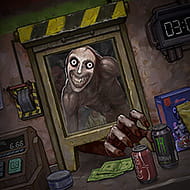
The Soda Man remains the community’s favorite recurring stress test — run short on stock and he’ll show up demanding six cold ones with zero patience for excuses, a detail regular players bring up constantly when comparing notes. What makes him a useful benchmark rather than just a running joke is that his patience threshold seems to scale with how often you’ve already failed him earlier in the same shift.
Players who favor careful, observational horror games tend to enjoy this layer of Retail Hell the most, since success depends on noticing small deviations in a customer’s dialogue or behavior rather than reacting to an obvious jump scare. That slower read-the-room style contrasts with how aggressively the game can escalate once a genuine threat does show up.
The Harvester and the Stalker as Recurring Threats
Unlike the store’s cordial regulars, the Harvester and the Stalker are explicitly hostile, and distinguishing their approach from ordinary customer behavior becomes second nature only after you’ve been caught off guard at least once. Losing the store to either one means losing your soul along with it, which the game treats as a literal stake rather than a metaphor.
The Harvester tends to announce itself through environmental shifts before it’s directly visible — a detail players have started cataloguing as one of the more reliable early warnings once you know to look for it. The Stalker, true to its name, behaves more patiently, lingering at the edges of the store rather than approaching directly, which means panicking and running toward it is often worse than holding your position.
Early shifts rarely feature either threat in a meaningful way, which lulls new players into treating the job as a pure management sim before the horror layer fully kicks in. Once the Harvester starts appearing in regular rotation, that assumption stops holding, and players who haven’t already built the habit of watching for its tells tend to struggle the most during that transition.
Endless Mode Run Modifiers Explained
Endless Mode layers optional run modifiers on top of the base shift loop, letting players tune the pace of demand and threat frequency to their own preference. It was added specifically in response to feedback that the base experience felt either too punishing or too slow for some playstyles, and it has become a favorite among players who want to push personal survival records rather than follow the story.
Modifiers can push toward more aggressive customer demand, more frequent Harvester and Stalker appearances, or steeper delivery fees, and stacking several at once is how the community’s most dedicated players chase longer and longer survival streaks. It effectively turns Retail Hell into a scoring game once the narrative shifts are behind you.
Players who finished the story mode primarily for Lena and the Contract subplot sometimes bounce off Endless Mode entirely, since it strips away the character beats that made the story shifts memorable in the first place — a trade-off the mode makes deliberately rather than as an oversight.
Multiple Endings in Retail Hell Explained
Decisions around specific items, including whether you keep a Contract for yourself or hand it to a fellow trapped soul named Lena, ripple outward into how your story concludes. It’s a small choice in the moment that carries real narrative weight later, and it’s one of the more discussed decision points among players comparing endings.
Handing the Contract to Lena secures her a way out of purgatory, an outcome many players describe as the more emotionally satisfying resolution even though it means walking away from a resource that could have benefited Dan directly. Keeping it instead changes the tone of the closing shift noticeably, trading that payoff for a more self-interested conclusion.
Because the Contract decision happens relatively early relative to when its consequences play out, first-time players often make the choice without realizing how much weight it will carry by the final shift, which is part of why a second playthrough focused specifically on Lena’s arc is a common recommendation in community discussion.
Why does the inventory system feel random sometimes?
Stock demand leans on a degree of chance by design, which some players find adds tension and others find frustrating when it undercuts careful planning around items like the Soda Man’s usual requests — it’s one of the more consistently debated aspects of the game.
Are the technical issues serious enough to worry about?
Cursor flickering and occasional input lag on certain graphics settings affect some players more than others, enough to disrupt immersion during tense moments with the Harvester or Stalker without derailing a shift entirely.
Whether you finish a shift by handing the Contract to Lena, holding your own against the Harvester, or just keeping the Soda Man satisfied one more night, Retail Hell makes the debt to faceless management feel more dangerous than anything hiding in the aisles.
Comments
There are no reviews yet. Be the first one to write one.