









The Happyhills Homicide

 Loading...






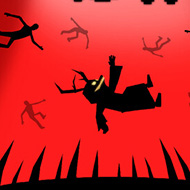


The Happyhills Homicide opens with a phone ringing in a cramped little office. The person picking it up is not a police detective but a self-employed paranormal investigator who has built an entire career out of telling nervous homeowners that their ghost is actually a loose pipe or a stray cat in the walls.
| Genre | Point-and-Click Mystery Horror |
| Platform | Browser |
| Controls | Mouse only, click to move and interact, click again to zoom |
| Structure | Case-by-case house calls that build into one connected story |
A Business Built on Debunking, Not Believing, in The Happyhills Homicide
Every early case in The Happyhills Homicide starts the same way: a client calls in convinced their house is haunted, and it’s your job to walk through, listen to their account, and find the mundane explanation hiding behind the scary one. A creaking floor turns out to be a loose board. A cold draft turns out to be a gap under a window frame. The dry humor comes from how confidently the investigator explains all of this to clients who clearly wanted a more exciting answer.
Beginners tend to treat the early cases like a checklist, clicking through rooms as fast as possible to trigger the next line of dialogue. That approach works fine at first, but it means missing small visual jokes and background details that make the debunking cases worth slowing down for.
What players search for most after finishing an early case is usually some version of how long the whole story runs. The honest answer is that it plays out over a handful of connected house calls rather than one long single sitting, each case short enough to finish in one go but building toward something bigger than the joke of the week.
Rocky at Your Side on Every House Call
You don’t do this job alone. Rocky, a small dog who rides along to every client’s house, is technically just a companion for most of the early game, sniffing around rooms and occasionally reacting to something the investigator walks right past. He’s not a mechanic so much as a presence, the kind of detail that makes the office-to-house-call routine feel lived-in rather than sterile.
New players often assume Rocky is purely decorative dialogue flavor, since nothing in the opening cases asks you to use him directly.
That assumption is exactly what The Happyhills Homicide is counting on, because Rocky’s role in the story stops being incidental once the plot turns. Players who paid attention to his small reactions in earlier houses tend to feel that shift land harder than players who clicked past him.
Reading a Client’s House as a Cross-Section
Each location is shown as a sliced-open cross-section of the building, every room visible at once stacked on top of each other rather than hidden behind separate screens. Moving between floors means clicking up or down through the layout, and it takes a case or two before the geography stops feeling disorienting.
A typical house call follows a fairly consistent rhythm once you’ve done a few of them.
- The phone rings and a client describes their supernatural complaint.
- You and Rocky travel to the client’s house, shown as a full cross-section.
- You click through each room, talking to the client and examining objects.
- Zooming in on specific objects reveals the physical explanation behind the scare.
- You report the mundane cause back to the client and close the case.
By the time you’ve handled a few cases, jumping between floors feels less like a gimmick. It’s the fastest way to catch a detail a client left out.
Zooming In: The Small Detail That Breaks a Fake Haunting
The clue-finding itself leans on a simple zoom function, letting you click into a cluttered shelf or a dark corner to spot something the wide shot hides. Most cases hinge on one or two objects that only make sense once you’re looking closely, and the game rewards players who poke around rooms rather than beelining for whatever glows brightest on screen.
The explanations behind each haunting draw from a fairly familiar bag of household culprits. Part of the fun is guessing which one applies before you find it.
- A pet that’s gotten trapped somewhere it shouldn’t be.
- Old plumbing or wiring making noises a client has never noticed before.
- A window or vent letting in wind at just the wrong angle.
- Something a family member moved and forgot to mention.
By the later cases the objects worth zooming into get less obviously mundane. That shift in what the zoom function reveals is one of the clearest signs the story is about to stop playing fair with the debunking formula.
The Moment Comedy Turns Into Something Real in The Happyhills Homicide
For most of its runtime this reads as a comedy first, a horror game second, full of dry one-liners about gullible clients and obviously fake hauntings. Then something happens to Rocky partway through, and the tone doesn’t just shift, it inverts, turning what looked like a joke-of-the-week structure into a personal, considerably darker story about an investigator who spent the whole game explaining away ghosts only to run headfirst into a real one.
Players consistently point to this exact turn when asked whether The Happyhills Homicide is actually scary. The honest answer is that it isn’t, not really, until this specific point, after which the cross-section houses stop feeling like comedic sets and start feeling like places you don’t want to zoom into.
What makes the reveal work is how little it changes mechanically. You’re still clicking through the same cross-section rooms, still zooming into objects for clues, but the debunking logic that felt reliable for every earlier case stops applying, and figuring out exactly when it stops applying is part of what players discuss most.
What Beginners Assume About the Early Cases
New players routinely underestimate how much the early, lighter cases matter later. Because the first few houses train you to expect a mundane explanation every time, the instinct to distrust anything genuinely strange gets reinforced right up until the game needs you to drop it.
That’s also why some players find the early pacing a little slow on a first run. The joke-driven debunking loop repeats a few times before the story underneath it starts to surface.
Once you know the twist is coming, replaying those early house calls changes how every offhand comment from a client, or every small reaction from Rocky, reads on a second pass. Nothing about the cross-section layout changes, only how carefully you look at it.
Balancing Dry Humor With Genuine Dread in The Happyhills Homicide
What keeps The Happyhills Homicide from feeling like two disconnected games stitched together is that the humor never fully disappears, even after the tone turns. The investigator keeps the same sarcastic voice from the debunking cases, just aimed at something that can no longer be explained away with a loose pipe or a stray cat.
This is also the aspect players debate most: some feel the mid-game turn is the best twist they’ve seen in a short browser mystery, precisely because the setup never telegraphs it, while others feel the shift arrives abruptly enough that it undercuts the comedic momentum the first half spent building. Both reactions show up constantly among people discussing this game.
Whether the tonal whiplash works for you personally seems to depend on how attached you got to the joke-of-the-week rhythm before it broke. That’s exactly the kind of reaction a well-built twist is supposed to produce.
Why the Twist Still Lands After You Know It’s Coming
Even on a second playthrough, knowing exactly when the story turns doesn’t drain all the tension out of it. The earlier cases hide enough small, easy-to-miss details, a look from Rocky, a client’s odd phrasing, that a repeat run feels less like a spoiler and more like catching a magician’s setup after you already know the trick.
It’s a short enough story that a full replay to catch those details doesn’t feel like a chore. That’s part of why it circulated so widely among players looking for a mystery-horror game they could finish in one sitting and immediately want to run again.
The Happyhills Homicide earns its reputation on that exact structure. A debunking comedy quietly sets up a real haunting, a dog named Rocky carries more weight than his early scenes let on, and the same cross-section house never stops being the set even after the story living inside it changes completely.
Comments
There are no reviews yet. Be the first one to write one.