





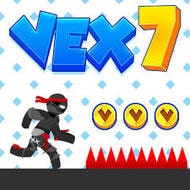
Vex 7

 Loading...







The grappling hook in Vex 7 does not work the way most players expect the first time they grab one. It’s not a point-and-swing tool like in a lot of other platformers, it’s tied to fixed anchor points placed by the level, which means the real skill isn’t aiming, it’s knowing exactly where those anchors sit before you’re already falling past them.
New Tools That Weren’t in the Earlier Games
Vex 7 adds a set of traversal options that change how a level can be built around them: zip lines for covering long horizontal gaps fast, grappling hooks for closing vertical distance onto a fixed point, and parachutes for controlling a long fall instead of just hoping the landing is clear. Throwable projectiles and TNT round out the set, giving a couple of sections a puzzle element where clearing a path means destroying part of the environment rather than jumping past it.
- Zip lines: fast, fixed-path traversal across gaps too wide for a standard jump.
- Grappling hooks: anchor to a set point rather than a free-aim swing.
- Parachutes: slow a fall enough to control where you land instead of just surviving it.
- TNT and throwables: clear specific obstacles rather than jumping around them.
None of these replace the run-jump-slide-wall-jump core the series is built on. They layer on top of it, which is why a level built around a zip line chain still expects the same precision on the jump connecting one line to the next, even as the game asks you to juggle a new tool on top of movement you already had to master in earlier entries.
Underwater Sections Change the Rules Entirely
The underwater levels in Vex 7 aren’t just a visual reskin of normal platforming, they swap out the jump-and-fall physics for buoyancy and current, which means momentum carries differently and a mistimed move doesn’t just cost you a life the way it would on solid ground, it can drift you straight into a hazard you weren’t lined up for. Laser traps show up specifically in these sections more than anywhere else, adding a hazard that doesn’t care about your swimming speed the way a saw cares about your running speed on land.
Tower of Terror Returns as the Series’ Hardest Mode
Alongside the main level list, Vex 7 brings back the Tower of Terror challenge mode, a set of short, extremely difficult standalone rooms rather than full levels. Each room in the Tower is built around a single brutal combination, spinning blades that circle a tight space, shooting knives fired on a rhythm, falling blocks timed to land where you’re forced to stand, and expects you to solve it in isolation without the run-up or breathing room a normal level provides.
- Treat your first attempt at a Tower room as pure information gathering, not a real try.
- Isolate the one hazard doing most of the killing before worrying about the rest of the room.
- Only commit to a full run once you can predict that hazard’s timing without watching it directly.
Traps That Punish Instinct Over Memorization
Blades that move in circles or swing from one side to another are the signature Vex 7 hazard, and they’re deliberately harder to read on instinct than the saws and spikes from earlier games, since their arc doesn’t match the straight-line timing most players bring in. Combined with the new grappling and zip line tools, a section can demand a specific route through moving blades rather than just fast reflexes, which is a shift the series hadn’t really asked for before.
Why doesn’t my grappling hook swing freely like it does in other games?
Vex 7’s grappling hook connects to fixed anchor points set by the level rather than any surface you aim at, so the skill is positioning yourself to reach a known anchor rather than free-aiming a swing on the fly.
What makes the Tower of Terror harder than the main Vex 7 levels?
Tower of Terror rooms are short, self-contained challenges built around one brutal hazard combination, usually circling blades or timed falling blocks, with none of the run-up or checkpoint spacing that the main levels use to ease you into a hard section.
Are the underwater levels in Vex 7 optional?
No, the underwater sections are part of the main level progression, and they swap the usual jump-and-fall physics for buoyancy and current, so momentum and hazard timing both work differently than they do in the standard platforming stages.
What sets Vex 7 apart from the rest of the series isn’t really the difficulty curve, since every entry in this stickman parkour line is punishing in its own way, it’s that tools like the grappling hook and zip line force you to plan a route through a level in advance instead of reacting hazard by hazard, which is a different kind of pressure than the reflex tests the earlier games leaned on.
Comments
There are no reviews yet. Be the first one to write one.